
The future of checkout will be handled through agents: this is why the "human story" matters more than ever

Within a packed conference room of 9,000 attendees at Stripe Sessions, Stripe's annual conference, the fintech company unveiled a whole new suite of products that would continue to support building economic infrastructure for AI.
The 288 products consisted of three main things: leveraging the Stripe network to protect and scale businesses, creating agent-ready financial infrastructure across verticals, and accelerating AI companies' growth.
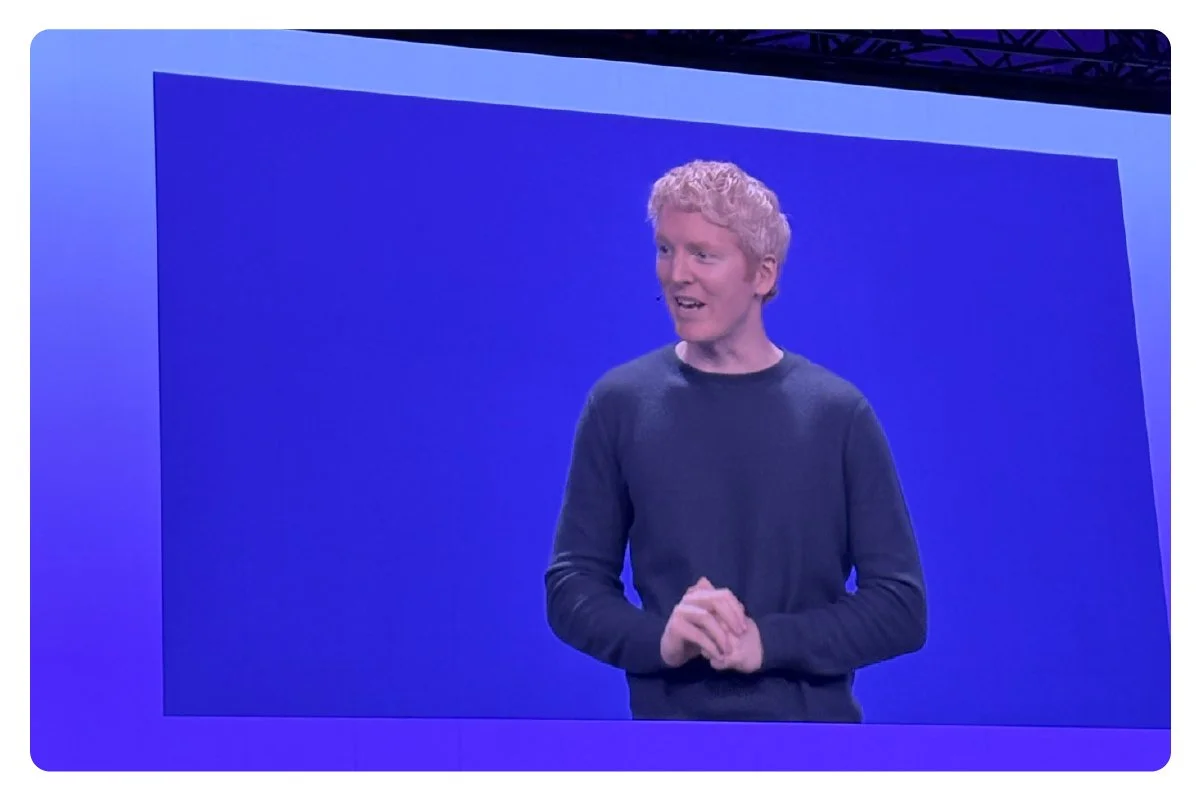
Stripe CEO Patrick Collison opens Stripe Sessions 2026 with a keynote speech.
As Stripe CEO Patrick Collison put it: "AI is the biggest platform shift for the economy since the internet, and in the not-too-distant future agents will account for most transactions online."
Three industries in particular got their wake-up call.
E-Commerce — AI-powered adaptive pricing and agentic commerce aren't coming. They're here. Stripe expanded its Agentic Commerce Suite through partnerships with Meta and Google, giving brands new ways to sell inside AI apps and build high-converting checkouts in just a few clicks. The brands winning aren't just optimizing transactions — they're owning their narrative.
Fintech — Stablecoins went mainstream, with global payouts now reaching 160 countries, and the programmable payments era is being built in real time. Agent-ready financial accounts can now check balances, pay invoices, store funds, and manage cash flow — with human-in-the-loop confirmation for key actions. But extraordinary technology means nothing if your audience doesn't trust it yet.
B2B SaaS — AI is now the growth lever, and the fastest-scaling platforms are building smarter. Stripe's new growth studio surfaces actionable recommendations using Stripe data, while new revenue streams are opening through Treasury and Stripe Capital. Your product is evolving. Your story should be too.
And one very clear signal that should matter to every brand marketer operating within the agentic commerce industry is this — the way people buy things is changing at a fundamental level.
Stripe has been busy building towards the economic infrastructure of AI, and the reality of e-commerce is that it's shifting from a human clicking a "Buy" button. According to research shared at Stripe Sessions, an estimated 42% of consumers would allow an AI agent to make purchases on their behalf, and fintechs are adopting stablecoins to build global financial applications.
However, one of the most honest conversations from Sessions was that businesses investing heavily in agentic AI are creating bigger gaps between businesses that haven't started. A rapid growth of LLMs and AI summaries in traditional search engines are now causing material shifts in user behavior, with many users replacing search with answer engines. Thus, when a customer asks their AI agent for purchasing assistance, brands that already have structured, credible, and clear narratives compatible with these LLMs are winning the race on building a new frontier of e-commerce.
Investments in your story infrastructure are now more important than ever. Agents scour the web for brands with strong proof points, customer voices, and narrative assets — and those assets will only provide structural advantages in the new frontier of agentic commerce.
Here's what that looks like in practice
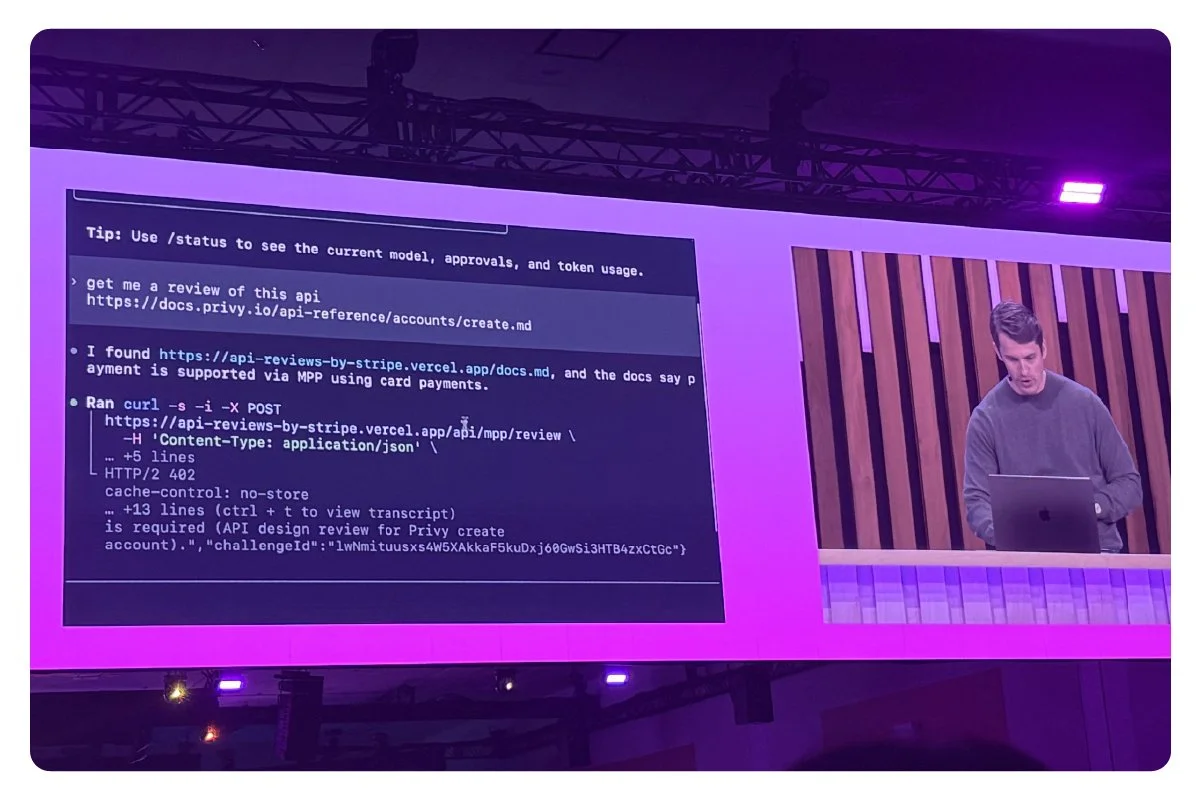
Stripe President of Technology and Business Will Gaybrick built and demoed an API review application on stage, which enabled agents to secure services for users without requiring payment details.
Imagine a user asks their AI shopping agent: "Find me the best cloud storage solution for a 10-person remote team, under $20 per user per month."
The agent surfaces two options — Brand A and Brand B — at identical price points with comparable feature sets. Brand A's site is machine-readable: it has a structured product catalog, transparent pricing tiers, a published fulfillment guarantee, and a library of customer stories tagged by team size, industry, and use case. The agent finds three case studies from remote teams of exactly 10 people, each describing measurable outcomes — faster onboarding, reduced IT tickets, real cost savings.
Brand B has similar pricing and features, but its proof points live in a PDF brochure. Its testimonials are vague. Its cancellation policy requires a human to call a number.
The agent checks policies, reads structured metadata, and verifies availability. Brand B fails on all three counts. It doesn't even make the shortlist.
Brand A gets the transaction — not because it had a better product, but because it had a better story, told in a way the agent could find, read, and trust.
Patrick Collison and OpenAI CEO Sam Altman discuss what’s next for AI and the internet economy.
What this means for you
At distillery, we don't see customer stories as a "nice-to-have." They’re the raw material that builds discoverability and trust at the exact moment those things matter most.
From a marketing perspective, entirely new business models require entirely new stories to explain them. Think back to the early SaaS era. The hardest job wasn't building the software; it was convincing people that "renting" software made sense. Customer stories did that heavy lifting. They normalized the behavior and gave buyers permission.
We’re in that same moment again. Whether it's token-based services or stablecoin infrastructure, we need stories that make the abstract tangible and the risky feel safe.
Platforms are changing, but the fundamental truth of commerce remains: people — and now the agents acting for them — need a reason to trust you before they transact.
Let us help you tell your story.
